
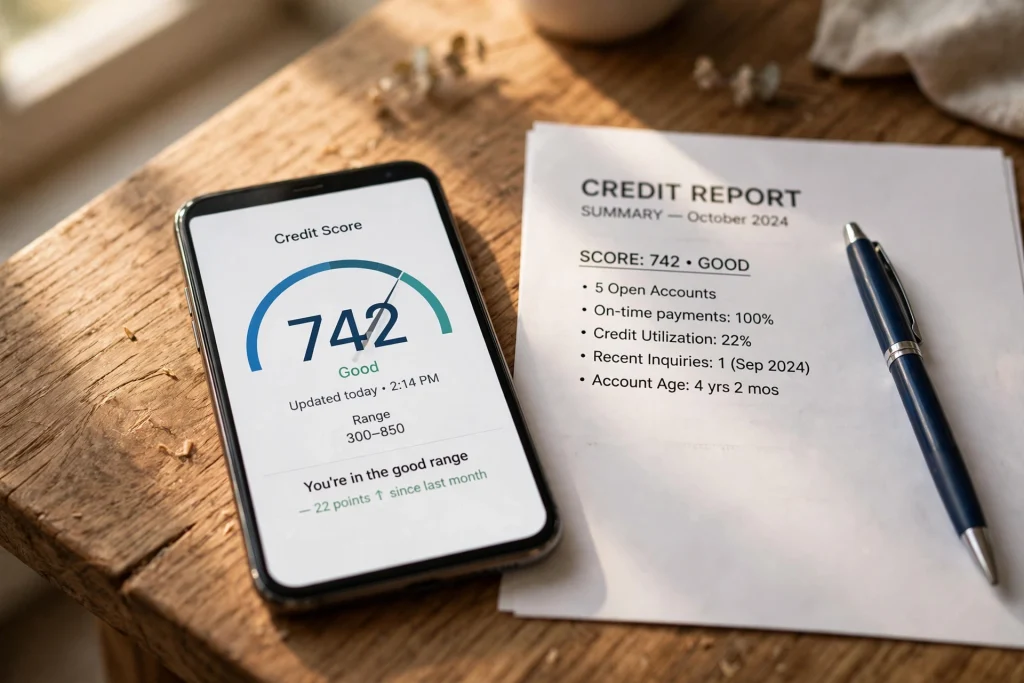
Most people I know have never seen their credit score. Not because they do not care. Because they are scared of it. They heard that checking your score makes it drop, so they leave it alone and hope for the best.
That fear is based on a myth, and the myth costs people money. A landlord, a car dealer or a card company can see your score any time they have a reason to. The only person locked out is you.
The truth is simple. Checking your own credit score is free, it takes about two minutes, and it never hurts your score. Not a little. Not at all. This guide shows you every legit place to get it, what the number means, and the traps that catch people who go looking in the wrong place.
Quick answer: Checking your own score is a soft inquiry, and soft inquiries have zero effect on your score. For the number itself, open a free Experian account for a real FICO Score, or use Credit Karma or Capital One CreditWise for a free VantageScore. Both are free with no card required. For the full story behind the number, pull your free weekly credit reports at AnnualCreditReport.com, the only site authorised by US federal law. A report and a score are two different things, and you want both.
Credit Score vs Credit Report: The Difference That Matters
Almost every confusing thing about this topic comes from two words being used as if they were one. They are not.
Your credit report is the full record. It lists your cards, your loans, your payment history, your balances and who has looked at your file. Three companies keep these reports on you. Equifax. Experian. TransUnion. Each one holds a slightly different version, because not every lender reports to all three.
Your credit score is a single number built from that record. It runs from 300 to 850. Two scoring companies do most of the maths. FICO is the older one and still the one most lenders use. VantageScore is the model the three bureaus built together. Same report underneath, slightly different maths on top.
So when a site offers you a free score, it is showing you one number from one report on one day. When you pull a report, you see everything the number is made of. The score tells you where you stand. The report tells you why.
Does Checking Your Own Credit Score Hurt It?
No. And it helps to know why, because the word "inquiry" is where the fear comes from.
Every time someone looks at your credit file, the look is recorded as an inquiry. There are two kinds, and they are treated completely differently.
| Type of check | What it is | Effect on your score |
|---|---|---|
| Soft inquiry | You check your own score or report. A bank shows you your score in its app. A card company screens you for a pre-approved offer | None. Zero. Check as often as you like |
| Hard inquiry | You apply for a card, a loan, a mortgage or finance, and the lender checks your file to decide | Small and temporary. Usually fewer than 5 points, and it stops counting after about 12 months |
Read that first row again. Every method in this guide is a soft inquiry. The US Consumer Financial Protection Bureau says it plainly. Checking your own credit does not hurt it.
Hard inquiries are a normal part of life too. One application will not wreck anything. A pile of applications in a few weeks can cost you a few points and makes lenders nervous, which is the real thing to avoid. But looking at your own score is not an application. It is just looking.
The Free Ways at a Glance
You should never pay to see your own score. Between the bureaus, the banks and the free services, every angle is covered. Here is the whole map in one table.
| Where to check | What you get | Score model | Who can use it |
|---|---|---|---|
| Experian free account | Score plus your Experian report | FICO Score 8 | Anyone, free account |
| Discover Credit Scorecard | Score only | FICO Score 8 | Anyone. No Discover card needed |
| myFICO free plan | Score only | FICO Score 8 | Anyone, free account |
| Equifax Core Credit | Score plus your Equifax report | VantageScore 3.0 | Anyone, free account |
| Credit Karma | Two scores plus two reports | VantageScore 3.0 | Anyone, free account |
| Capital One CreditWise | Score plus monitoring | VantageScore 3.0 | Anyone. No Capital One account needed |
| Chase Credit Journey | Score plus monitoring | VantageScore 3.0 | Anyone, free account |
| Your own bank or card app | Score inside your account | FICO or VantageScore | Customers of that bank or card |
| AnnualCreditReport.com | Full reports from all three bureaus. No score | None | Anyone, weekly |
Two things in that table are worth saying out loud. First, the free FICO scores are the real thing. FICO Score 8 is the version most lenders still use, and Experian and Discover hand it out free. Second, TransUnion is the odd one out. It does not give a free score on its own site and pushes a paid monitoring plan instead. You do not need it. Credit Karma shows you your TransUnion based score free.
Way 1: Your Bank or Card App (The One You Already Have)
Start where you already have an account. Most big card companies and banks now show a free score inside their app or on your statement. Discover, Citi and Bank of America show a FICO Score. American Express and Chase show a VantageScore. If you carry a card from any of them, your score is probably sitting there already.
- Open your banking or card app and sign in.
- Look for a menu item called Credit Score, Credit Journey, CreditWise or FICO Score. It often hides under Services or Tools.
- Tap it and confirm your identity if the app asks.
- Note three things on the screen. The number. The scoring model. And the bureau it came from. You will want those later when another site shows you a different number.
This is the check I do most often, because it takes ten seconds and the app is already on my phone. One small snag. If your phone is so full that the bank app will not install or update, clear some room first. Our guide on how to free up space on Android clears gigabytes in minutes without touching your photos.
Way 2: A Free FICO Score From Experian or Discover
If your bank only shows a VantageScore, or shows nothing at all, go and get a FICO Score free. Two routes need no card and no trial.
Experian. Create a free account on Experian’s site or app. The free tier gives you your FICO Score 8 built from your Experian report, plus the report itself. Experian will offer you paid upgrades on almost every screen. Decline them. The free score updates about once a month and that is plenty.
Discover Credit Scorecard. This one surprises people. You do not need to be a Discover customer. Anyone can sign up and see a FICO Score 8 based on Experian data. It exists because Discover hopes you will like them and apply for a card one day. Their hope costs you nothing.
Either route takes about two minutes. You will be asked for your name, address, date of birth and Social Security number. That is normal. The bureau cannot find your file without them. What is never normal is being asked for card details. A free score never needs your payment card. The moment a site asks for one, close the tab. More on that in the Stay Safe section below.
Way 3: Credit Karma or CreditWise (Best for Watching the Trend)
A FICO Score tells you what a lender sees. A VantageScore from Credit Karma tells you which way you are moving, and it updates far more often.
Credit Karma gives you two scores, one built from your Equifax report and one from your TransUnion report, refreshed about weekly. It also shows the reports behind them in a readable form, and it alerts you when something changes. A new account appears. A balance jumps. An inquiry lands. That early warning is worth more than the number itself, because it is how people catch identity theft early.
Capital One CreditWise does a similar job and is open to everyone, customer or not. Chase Credit Journey is another free option with the same idea.
Is the Credit Karma number accurate? It is a real score from real bureau data. It is simply a different model than the FICO Score a lender may use, so the two rarely match to the point. Use Credit Karma for the trend and the alerts. Use a free FICO Score when you want the lender’s view before a big application. The FAQ below explains the difference in full.
Way 4: Your Full Reports at AnnualCreditReport.com
The score is the headline. The report is the story, and the story is where mistakes hide.
AnnualCreditReport.com is the only website authorised by US federal law to give you your reports. You can pull a report from each of the three bureaus every week, free. That weekly access started during the pandemic and the bureaus made it permanent in 2023. The old rule of one free report a year is gone.
- Go to AnnualCreditReport.com. Type the address yourself rather than clicking an ad. Lookalike sites exist.
- Enter your name, Social Security number, date of birth and address.
- Choose one bureau, two, or all three.
- Answer the identity questions. They ask about old addresses and old loans to prove it is you.
- Read the report on screen, then save or print a copy before you leave the page.
You do not have to pull all three on the same day. Some people pull one bureau each week on rotation, so a fresh report is never more than a few days old. There is no wrong pattern. What matters is that you look.
Read each report with four things in mind. Accounts you do not recognise. Balances or late payments that are wrong. Addresses you have never lived at. And inquiries from lenders you never applied to. Any one of those can mean an error, or worse, someone using your identity. The errors section below shows what to do next.
Prefer not to do it online? You can request reports by phone at 1-877-322-8228, or by mail with the request form sent to Annual Credit Report Request Service, P.O. Box 105281, Atlanta, GA 30348-5281.
What Your Score Actually Means
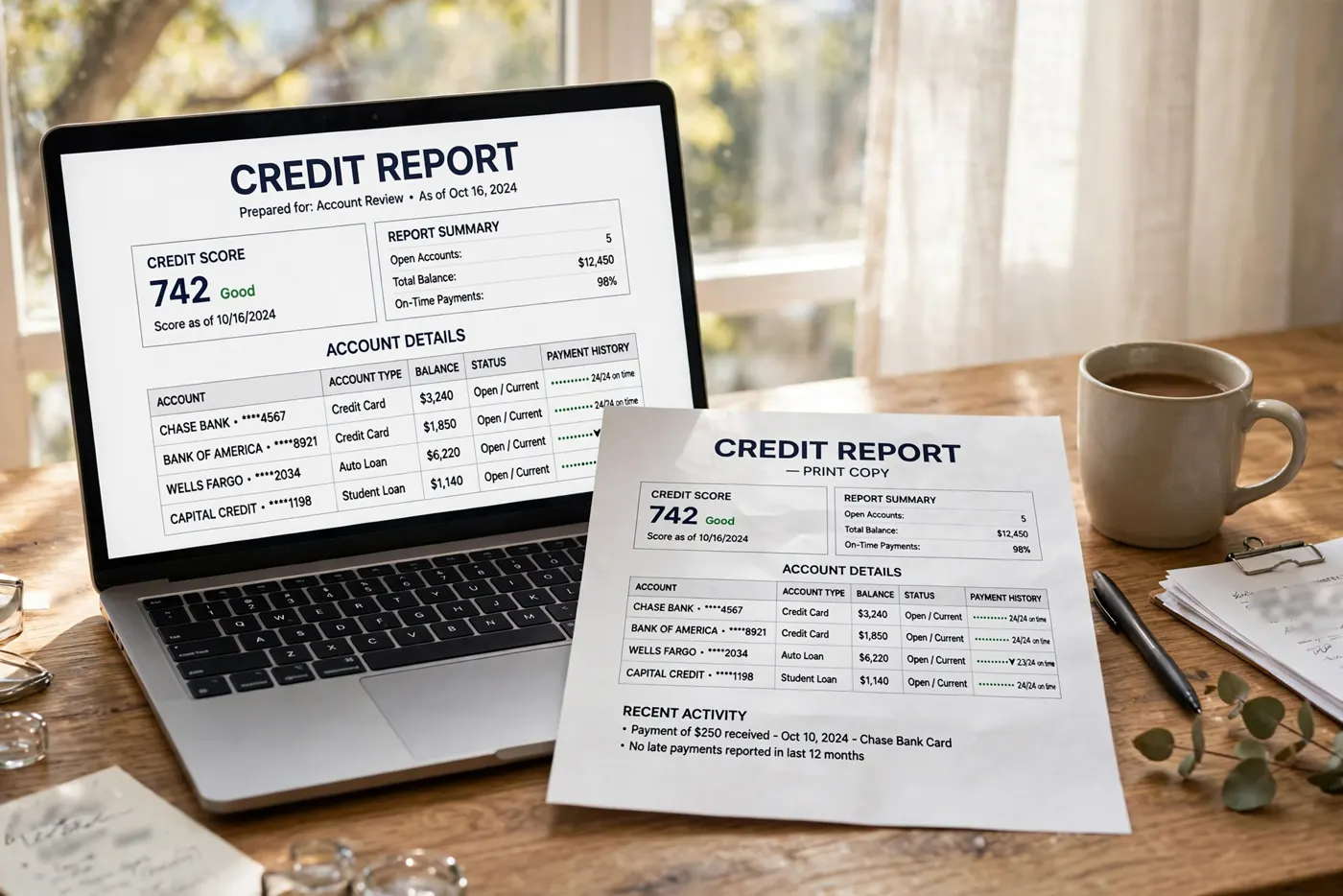
A number on its own tells you little. Here is how the two main models slice the 300 to 850 range, so you can place yours.
| Range | FICO label | VantageScore label | What it means in real life |
|---|---|---|---|
| 800 to 850 | Exceptional | Excellent | Best rates on almost everything |
| 740 to 799 | Very good | Excellent | Approved easily, near-best rates |
| 670 to 739 | Good | Good | Most lenders say yes. Rates are fair |
| 580 to 669 | Fair | Fair | Approvals get harder and pricier |
| 300 to 579 | Poor | Poor | Most applications refused or very costly |
The bands differ a little between the models. VantageScore counts 661 to 780 as its Good band, while FICO counts 670 to 739 as Good. That is one more reason two sites can show you two numbers and two different labels for the same week of your life.
A rough rule of thumb covers most of life. Above 670, you are in the zone where normal borrowing works. Above 740, you start getting the rates they advertise. Below 580, the job is repair before borrowing. Wherever yours sits, it is not fixed. Scores are rebuilt out of ordinary habits. Pay on time every time. Keep card balances well under their limits, under 30 percent at most and under 10 percent if you can. Leave old accounts open. Apply for new credit only when you need it.
Why Your Score Is Different on Every Site
So you checked in two places and got two numbers, maybe 20 points apart. Nothing is broken. This is the most common confusion in the whole topic, and there are only three causes.
A different model. FICO and VantageScore weigh the same facts a little differently. Even inside FICO there are many versions. The score on your card statement and the score a mortgage lender pulls can be cousins, not twins.
A different report. Your three bureau reports are not identical. Some lenders report to one or two bureaus and skip the third. A balance or a late payment can sit on one report and be missing from another, so the scores built on them part ways.
A different day. Reports update as lenders send fresh data, and they do not all send it on the same day. A card you paid off last week may show as paid on one report and still open on another.
Chase the trend, not the exact number. If every version of your score is drifting up over the months, your habits are working, whatever the screens say on a given Tuesday.
Found an Error? How to Dispute It
Errors are not rare. In a study by the US Federal Trade Commission, about one in five people found an error on at least one of their three reports. Some errors are harmless typos. Others cost real points and real money. A wrong late payment. A card that is not yours. A loan marked unpaid years after you settled it.
You fix an error with a dispute, and the dispute is free.
- Note the error and which bureau’s report it sits on. An error can live on one report or all three.
- Gather proof. A statement showing the payment left your account. A letter closing the account. Whatever shows the truth.
- File the dispute with that bureau. Each bureau takes disputes online, by phone and by mail. Online is fastest to file. Mail gives you a paper trail.
- The bureau generally has 30 days to investigate. If you send more information during that window, it can stretch to 45 days.
- You get the result in writing. If the error is confirmed, it comes off the report and your score is rebuilt from the corrected file.
Dispute with each bureau that shows the error. Fixing it at Experian does not fix it at TransUnion. And if the error looks like fraud rather than a mistake, an account you never opened in a state you never lived in, treat it as identity theft. Place a free fraud alert or a credit freeze with the bureaus, and report it at IdentityTheft.gov.
No Score at All? The Thin File Problem
Sometimes you do everything right and the site shrugs. No score found. That usually means your credit file is too thin to score, not that you did something wrong.
A FICO Score needs at least one account that has been open for six months or more, with activity reported in the last six months. VantageScore can build a score from a much shorter history. So a newcomer can have a VantageScore months before a FICO Score exists.
This catches young adults opening their first account. It catches people who have lived on cash and debit for years. And it catches people new to the US, whose years of clean history in another country do not travel with them.
The way out is slow and boring, which is another way of saying it works. A secured card used for one small bill and paid in full each month. Becoming an authorised user on a family member’s older card. A small credit builder loan from a credit union. Six to twelve months of that and a score exists, then starts to climb.
Stay Safe: The Free Score Traps
Anything free and popular attracts fakes. Credit scores are both. Four traps catch most people.
Lookalike sites. Sites with names close to AnnualCreditReport.com exist to harvest your details or sell you monitoring. There is exactly one official address. Type it yourself. Never arrive at it from an ad or a search result that says "sponsored".
The free trial that is not free. Some services offer a free score and ask for your card "for verification". Then a monthly monitoring fee starts, often $20 to $40, buried in small print. A genuinely free score never needs your card. If a site asks for payment details, it is not the free route. Leave.
Fake score apps. Apps outside the official stores promise instant scores and deliver ads, or worse, steal the very details that protect your identity. Only install a finance app from the Play Store or App Store listing of the real company. If someone sends you an app file directly, read our guide on how to check if an APK is safe before you touch it. Better still, do not touch it.
Your details are the product. Even the legit free services show you offers for cards and loans. That is how they make money, and it is fine, as long as you remember the score is free and the offers are optional. You never have to apply for anything to keep your free access.
A Simple Routine That Takes Five Minutes a Month
Checking once is good. Checking on a rhythm is what catches problems while they are still small. Here is the routine I use, and it costs nothing but a few minutes.
- Every month: glance at your score in your bank app or on Credit Karma. You are looking for surprises, not decimals. A sudden drop you cannot explain is a signal to dig.
- Every few months: pull one full report at AnnualCreditReport.com and rotate the bureau. Read it with the four checks from Way 4. Accounts, balances, addresses, inquiries.
- Before any big application: check a free FICO Score a month or two ahead. If there is an error to fix, you want the dispute clock running before the lender looks, not after.
- Once a year: pull all three reports on the same day and compare them side by side. Differences between bureaus are normal. An account on one report that exists on none of your statements is not.
That is the whole system. No paid monitoring. No daily obsession. Just a habit small enough to survive real life.
Reading This From the UK or Europe?
Credit scores work differently outside the US, and most guides pretend you do not exist. A short version for InfoZone readers elsewhere.
In the UK there is no single official score. Each agency sells its own number on its own scale, and lenders run their own checks on top. You can see all three free. Experian’s app shows its score out of 999. ClearScore shows your Equifax score out of 1000. Credit Karma’s UK app shows your TransUnion score out of 710. Checking any of them is free and does not harm you, the same as in the US.
In Germany the main file is held by SCHUFA. You have the right to a free copy of the data stored about you, often called the Datenkopie. Request it and it arrives by post. The glossy one-page certificate SCHUFA sells is not the same thing, and you do not need it to see your own data.
Across most of the rest of Europe there is no consumer score culture like the American one. Banks check registers of unpaid debts and their own records instead. The habit that travels is the one from this guide. Get your file. Read it. Fix what is wrong.
One practical note for anyone who has moved countries. Bank and card apps are often locked to the app store of one country, so your old banking app may refuse to install after a move. Our guide on how to download apps not available in your country covers the safe options, and the safe options matter double when the app holds your money.
One honest note before the questions. This article is educational information, not financial advice. Scores, models and free offers change over time, and your situation is your own. For decisions about debt or borrowing, a nonprofit credit counsellor can review your file with you for free.
Frequently Asked Questions
Does checking my credit score hurt it?
No. Checking your own score or report is a soft inquiry, and soft inquiries have no effect on your score at all. You can check every day if you like. What can cost a few points is a hard inquiry, which only happens when you apply for credit and a lender checks your file to decide. Even then the effect is small, usually fewer than five points, and it fades within about a year.
How can I check my credit score for free without a credit card?
Use a source that never asks for one. A free Experian account gives you a FICO Score 8. Discover Credit Scorecard gives the same score to anyone, customer or not. Credit Karma and Capital One CreditWise give free VantageScores. Your full reports are free weekly at AnnualCreditReport.com. None of these needs payment details. If any site asks for your card to show a free score, close it and use one of these instead.
What is a good credit score?
On the FICO scale, 670 to 739 counts as Good, 740 to 799 as Very Good, and 800 or above as Exceptional. Below 670 sits Fair, and below 580 sits Poor. VantageScore draws its lines in slightly different places, with 661 to 780 as its Good band. In daily life, a score above 670 opens most doors, and above 740 you start seeing the best rates lenders advertise.
Why is my credit score different on different sites?
Because three things can differ at once. The model, since FICO and VantageScore weigh the same facts differently. The report, since each bureau holds slightly different data and not every lender reports to all three. And the date, since lenders send updates on different days. Small gaps between sites are normal. Watch the direction over time rather than any single number.
Is Credit Karma accurate?
Yes, within what it claims to be. Credit Karma shows real VantageScore 3.0 scores built from your real Equifax and TransUnion reports, and it updates them about weekly. It is accurate as a VantageScore. It will usually differ from the FICO Score a lender uses, sometimes by a little and sometimes by more. Use it to follow your trend and catch changes early. Check a free FICO Score before a major application.
Does AnnualCreditReport.com give me a credit score?
No. It gives you the reports, not the scores. The three full reports from Equifax, Experian and TransUnion are free there every week, and they show every account, balance and inquiry behind your scores. For the number itself, pair it with a free score source such as Experian’s free account or Credit Karma. You want both. The score says where you stand and the report says why.
How often should I check my credit score?
As often as you like, since checking never hurts it. A rhythm that works for most people is a quick score glance once a month, one full report every few months on rotation between the bureaus, and all three reports together once a year. Check a free FICO Score a month or two before any big application, so an error has time to be disputed before a lender sees your file.
What should I do if I find an error on my credit report?
Dispute it with the bureau whose report shows it. Gather proof first, such as a statement showing the payment was made. File the dispute online for speed or by mail for a paper trail. The bureau generally has 30 days to investigate, or up to 45 if you send more information during the process. If the error is confirmed it is removed. Dispute separately with each bureau that carries the error, because fixing one does not fix the others.
Why do I have no credit score at all?
Most likely your file is too thin to score. A FICO Score needs an account open for at least six months with recent activity. If you are new to credit, new to the US, or have lived on cash and debit, there may not be enough history yet. VantageScore can score a shorter history, so try Credit Karma first. Then build the file with a secured card or a credit builder loan, paid on time, and a FICO Score will follow within months.
Can I check my credit score on my phone?
Yes, and for most people the phone is the easiest route. Bank and card apps show your score inside your account. Experian, Credit Karma, CreditWise and Credit Journey all have free apps too. Install them only from the official Play Store or App Store listing of the real company. Never install a credit score app from a file someone sends you, because fake versions exist to steal the details you would type into them.